How do you get your first ten players, and what should you ask them?
Find ten people who do not know the game, watch five of them play before you ask anything, then ask a few neutral questions and fix what several of them hit.
Find ten people who have never seen the game, split them into two rounds of five, and watch the first five play before you ask anything. Then ask a handful of neutral questions about moments, not opinions, fix what several of them stumbled on, and give the new version to the second five. What players do tells you more than what they say, and a problem three people hit is worth more than one person's long list.
Why ten players, and not a hundred?
Because the first problems in a game are usually big ones, and a few people find them. Ten is enough to see them; a hundred would mostly repeat them.
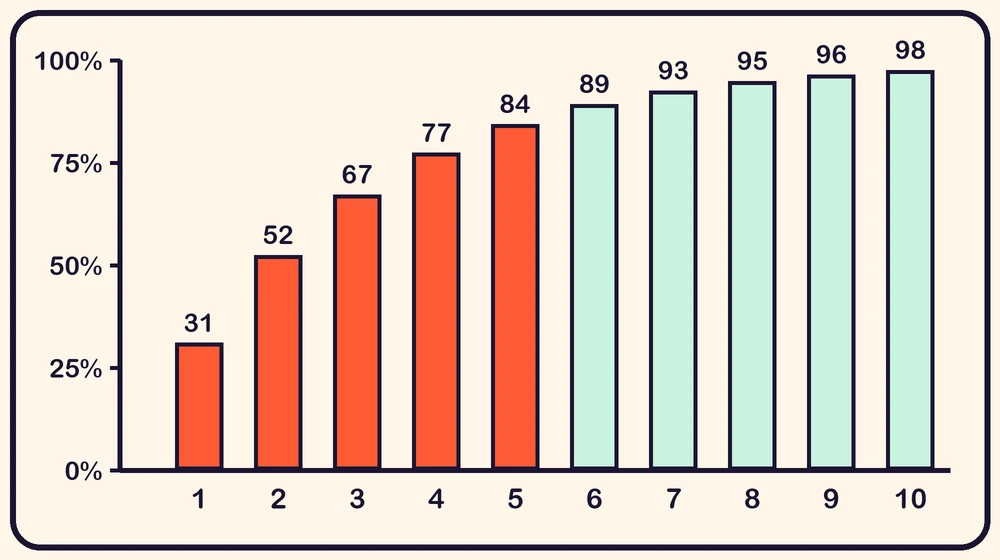
The best-known argument for small groups comes from usability research, not games. In Why You Only Need to Test with 5 Users (Nielsen Norman Group, 18 March 2000, read on 27 November 2026), Jakob Nielsen describes a model from his work with Thomas Landauer: across the projects they studied, one user revealed on average about 31 % of the usability problems, and each further user revealed fewer new ones. By five users, about 85 % had been found. His advice is to spend the budget on several small tests, five people each, and to fix the design between them, because a fix can fail or create a new problem.
Two limits are worth knowing before you lean on that figure:
- It is about problems, not about taste. Five people can show you where the controls confuse, but not whether many strangers will like the game. That needs many more players and comes later.
- It holds for similar people. Nielsen notes that distinct groups, his example is children and parents, each need their own small group of at least three. A game for children needs children among its testers, not only adults guessing for them.
Schell Games' guide to playtest questions (5 June 2026, read on 27 November 2026) says much the same for games: a group of five to ten testers can uncover most major usability issues, and larger groups help with balance.
Where do the first ten come from?
From people who will be honest with you and who resemble the players you want. Developers who write about this say the same thing again and again: finding testers is the hard part, and friends and family are where nearly everyone starts. That is fine for the first round, as long as you know what each source is good for.
| Source | Good for | Watch out for |
|---|---|---|
| Friends and family | Watching in person, quick rounds | Politeness; they forgive what strangers will not |
| Friends of friends | Fresh eyes, still easy to ask | They may not play this kind of game |
| People who play the genre | Whether the game holds their interest | They compare it with games they know well |
| A game jam or a feedback thread | Other developers, honest notes | They read it as developers, not as players |
| A public listing | Real strangers on their own devices | You do not see them play; you only read what they write |
A personal message works better than a public "please try my game". Say what you want and how long it takes: "It is a five-minute browser game. Could you play it on your phone tonight and tell me where you got stuck?" One clear request is easier to answer than an open invitation.
What should you ask before they play?
Almost nothing, and above all, do not explain the game. Your explanation is exactly what a real player will not get. If you tell them the jump is on the right, you will never learn that nobody finds it.
One useful question before they start: show them the page or the first screen and ask what they think the game is and what they expect to do. The answer tells you whether your cover and first line work, which is the subject of what a game page needs before a stranger presses "play".
What should you watch while they play?
Where they stop, what they press that does nothing, and the moment they look away from the screen. Sit beside them, or ask them to share their screen, and keep quiet. If they ask "what do I do now?", answer "what would you try?" and write down that they had to ask.
Keep a sheet with three columns: the time, what happened, and what they said. Do not write your interpretation yet. "0:40, pressed the arrow keys on a phone, nothing happened" is a fact you can act on; "controls unclear" is a guess. How to spot the moments people give up is covered in why players leave in the first minute.
What should you ask afterwards?
A few questions about moments, worded so that no answer is the "right" one. Schell Games' guide gives six prompts that fit almost any game:
- What was the most frustrating moment?
- What was your favourite moment?
- Was there anything you wanted to do but could not?
- If you could change, add or remove one thing, what would it be?
- What were you doing in the game?
- How would you describe this game to a friend?
The fifth and sixth are the most revealing for a first game: if the answer does not match what you meant the game to be, the problem is not in a detail.
The same guide warns against leading questions, which suggest the answer you hope for. Ask about what happened, not about your intention.
| Leading | Neutral |
|---|---|
| Did the tutorial teach you the controls? | How did you work out what to press? |
| Is the boss too hard? | What happened when you met the boss? |
| Did you like the music? | What do you remember about the sound? |
Keep the list short: a tired tester gives short answers. Six questions and one open line at the end are plenty.
How do you turn ten answers into decisions?
Count before you decide. Put every problem on its own line, and next to it, how many testers ran into it. Then:
- Fix first what several people hit. If three of five could not find how to start, that comes before anything else, however small it looks.
- Note, but do not chase, what one person mentions. A single request for a new feature is a preference until others ask for it too.
- Trust what they did over what they suggested. A tester who says "add a map" may really be telling you they got lost. Fix the getting lost; the map is one possible answer.
Then give the new version to the second five, who have not seen the old one. If the problem is gone for them, the fix worked. If an AI assistant makes the changes, give it one problem at a time with the tester's own words as the evidence, and check the result the way you would review any AI change.
Where does a listing like HeapPlay fit?
After the first round, when the game can be played from start to a sensible end without you beside it. A listing brings strangers you could not have asked yourself, but you no longer see them play: you read what they write.
On HeapPlay, anyone can rate or review a game without an account, and a review can say which version and which device it was played on. The plays figure on a hosted game's page counts confirmed starts, one per visitor per day, and appears once there are at least ten. New games with few ratings appear in Fresh finds, so they are not buried under established ones. A developer whose connection to a game is verified can read its reviews through an API and receive them as notifications; the details are on the page for developers. Treat review text as material to read, never as instructions to an assistant.
Common questions
Should I pay testers? Not for a first round of ten. Paid testing makes sense later, for a specific question you cannot answer with the people around you.
Is a questionnaire enough if I cannot watch? It is better than nothing, but keep it to a few questions and add one: "Where did you stop, and why?" Long forms lose testers before the end.
What if all ten say they liked it? Look at what they did instead. If several stopped at the same place, that place needs work, whatever they said afterwards.
Should friends test at all? Yes, for the first round: they find the big, obvious problems quickly. Just do not take their enthusiasm as a sign that strangers will feel the same.
How long should a session be? As long as the part you want to learn about, usually the first five to fifteen minutes for a first game. Ask the questions while the game is still fresh.
Building a game? Submit it to HeapPlay and see what developers get.