How do you make a browser game load fast on a phone?
Send less before the first moment of play, make sure the server compresses it, cache it for good, and measure on a slowed-down phone profile.
Send as little as possible before the player can start, make sure the server compresses what it sends, give every build its own address so the browser can keep it, and load everything else while the player is already playing. Then measure it on a slowed-down phone profile, from the tap to the first moment of real play. A game that waits for every file before it starts is as slow as its largest file on the worst connection.
What counts as "loaded" for a game?
Not the moment the page appears, and not the loading bar reaching the end. What matters is the first moment the player can actually do something.
CrazyGames, a web game portal, measures a game's first load "up to the moment your game calls the SDK gameplayStart method", and its guide on getting to the first frame (no date on the page, read on 21 November 2026) asks that this be real gameplay, not a loading screen. It is a useful rule even if you never use a portal: pick one moment in your own game, the first input that does something, and measure to that.
Why it matters is covered in why players leave in the first minute: a player who taps a link on a phone is deciding whether to stay while your files are still arriving.
Where does the time go on a phone?
Four places, and a phone is slower than your computer at every one of them.
- Downloading. The bytes have to arrive over a mobile connection.
- Waiting between requests. Every request takes time to answer, and a module that imports another module only asks for it after the first one has arrived.
- Starting the code. The browser has to parse and run your JavaScript, on a much weaker processor than the one you develop on.
- Building the game. Decoding pictures and sound, building levels and meshes, compiling shaders: work your game does before the first frame.
A slow load on a phone is usually one of these four. Measure before you guess which.
How big are real small browser games?
For a sense of scale, here are four of HeapPlay's own hosted games: every file of the version that is live, as it sits on disk and as the games server sends it. Measured on 21 November 2026 with curl, asking for compressed files, as a browser does.
| Game and version | Files | On disk | Sent |
|---|---|---|---|
| Code with Beep 0.2.0 | 13 | 248 KB | 76 KB |
| Acid Jungle 0.6.0 | 14 | 622 KB | 213 KB |
| Critter Billiards 0.1.1 | 17 | 913 KB | 256 KB |
| Tycoon Island 0.4.0 | 25 | 1,255 KB | 370 KB |
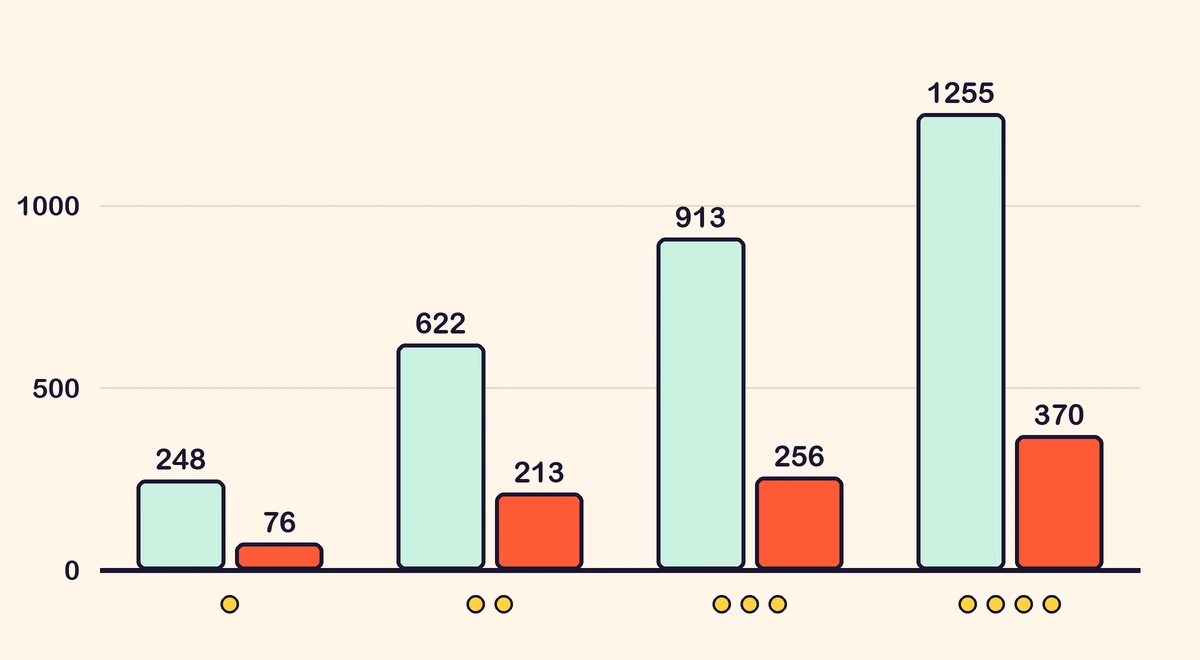
These totals include every language table, and a player does not always need all of them (see below). Apart from a small icon in three of them, none of the four ships a picture or sound file: their graphics and sounds are made by code while the game runs. That is one way to stay small, not the only one. For comparison, Elanra Studios, the team behind Cannon Clash on Poki, reported a whole game at "a lean 2.4 MB download size with only 76 requests" after the work described further down.
Is your server compressing the files?
Check it first, because it costs nothing to fix and is easy to miss. Text files (JavaScript, HTML, CSS, JSON) shrink a lot when the server sends them compressed with gzip or Brotli; in the table above, each game was sent at 28 to 34 per cent of its size on disk. Already compressed formats, such as most pictures, audio and video, gain almost nothing.
You can check one file from a terminal:
curl -s -o /dev/null -D - -H "Accept-Encoding: br, gzip" https://your-game.example/game.jsLook for a line content-encoding: gzip or content-encoding: br in the answer. If there is none, the file is sent as it is on disk. In the browser, the same header is shown in the developer tools' Network panel, under the request's response headers. On 21 November 2026 HeapPlay's games server answered with gzip, not Brotli, even when asked for both.
Some hosts do not compress every file type. Engine builds with .wasm or .pck files are a common case, which is why CrazyGames' guide asks for Brotli on .wasm, .js and .pck files.
What should load before the first frame?
Only what the first minute of play needs. Everything else can arrive while the player is already playing.
HeapPlay's own games show both ways. Acid Jungle loads the table for the player's language only, about 5 to 7 KB as sent. Tycoon Island 0.4.0 imports all eight of its translation tables when it starts, 63 KB as sent, whichever language the player reads. Neither is wrong for a game of this size, but the first is what scales.
More things that can usually wait:
- levels after the first one;
- music, when sound effects are enough for the opening;
- the second and third character, the shop, the credits;
- an intro animation. The Cannon Clash team removed theirs after playtests showed that players wanted to start straight away.
If something is slow to build, start building it while a screen the player needs anyway is shown. Acid Jungle's README records that since version 0.5.0 it makes 30 textures while the title screen is shown, in about 90 ms on the Apple M1 it was measured on.
How do you make the files themselves smaller?
Start with the largest file, because that is where the gain is. In the Cannon Clash write-up, from 11 November 2024:
- Compressed 3D models: one model file went from 3.88 MB to 387 KB with Draco compression.
- Compressed textures: an explosion sprite sheet went from 406 KB to 46.3 KB with Basis compression.
- Fewer requests: models were batched into one file and interface graphics into one sprite sheet.
- Less code: scripts the game did not use were left out of the build.
That article is on Poki's blog. It reports file sizes, not load times before and after, so it shows what shrank, not by how many seconds.
A library can also be the largest file. Critter Billiards and Tycoon Island both ship the three.js library, about 190 KB of their sent total. Each game keeps its own copy under its own address, so a player who has played one still downloads it for the other.
How do you make the second visit instant?
Give every build its own address and let the browser keep it. HeapPlay's games server puts the version in the address (for example /critter-billiards/0.1.1/app.js) and sends every file except the start page with Cache-Control: public, max-age=31536000, immutable: keep it for a year and do not ask again. The start page is sent with no-cache, so a new version is found at once. A changed file never reuses an old address, so nobody is left with a stale copy.
If your host lets you set headers, do the same. If it does not, at least put a version in your file names.
How do you measure it?
Use the same steps every time, so that two measurements can be compared:
- Open the browser's developer tools, empty the cache and choose a slow mobile connection and a slowed-down processor. How to do that, and what an emulated phone does not tell you, is in how to test a browser game without a test team.
- Load the game and note the time from the start to your chosen first moment of play. Repeat a few times and take the middle value.
- Look at the Network panel: the largest files, the number of requests, and whether they are compressed.
- Change one thing, then measure again in the same way.
- Before a release, try it on a real phone on a mobile connection.
If an AI assistant does the work, give it the measurement as the check, in the way described in how to write a task for an AI coding assistant: "Load only the player's language table at start; the other translations must not be requested; the first level must still start on a slow profile; report the total sent before and after."
Common questions
Is there a size limit I should stay under? There is no single standard. Measure your own game to its first moment of play, and make the largest file smaller first.
Do loading bars help? A bar tells the player that something is happening, but it does not make anything faster. Shortening the load does more than decorating it.
Should I minify my JavaScript? Yes, for a release build: it is smaller to send and to parse. Keep the readable source in version control.
Does a game engine make this harder? An engine adds its own runtime to the first download. CrazyGames' guide names Unity's Addressables and Godot's downloadable .pck files as ways to split it.
Where can players find small games that start fast? In HeapPlay's catalogue, for example Critter Billiards, a whole 3D game in about 256 KB as sent.
performance mobile browser-games
Building a game? Submit it to HeapPlay and see what developers get.